The anti-viral medicine I am on for Shingles makes me foggy and unable to concentrate well. (The warning label on the pill bottle says not to drive - no problem! Being contagious, where would I go?) So it doesn't surprise me that while I was in the refrigerator looking for something, I accidentally dropped the box of baking soda that was in there to absorb odors. Of course it split open; all over the floor and a small rug I have in front of the refrigerator door.
I was too tired to pull out the vacuum and too sore to beat the rug outside with my rug beater. (You do have a rug beater, don't you? You can see mine here.) My Hokey rug sweeper came to the rescue!
First, I used a broom to sweep up the baking soda from the floor and then swept the rug. (Did you know you can get a lot of dirt off a rug just by sweeping it with a broom?) Then I took the rug outside to shake it. While this did the trick for 90% of the problem, I still had a spot in the middle of the rug where the box broke open.
A few swipes with my Hokey and the problem was solved!
While the Hokey was really designed to pick up crumbs and other small objects (not powders), I think it did a very good job on the baking soda. I am satisfied until I have the energy to either beat it clean or pull out my vacuum.
I often use my Hokey to pick up dog hair, dirt as well as leaf & grass clippings brought in on wet paws, and crumbs that found their way to the floor after dinner. It is a very handy tool to have!
Although I am moving somewhat slower right now. For the third time in my life, I have the chicken pox. (After the first time, the disease is called Shingles.) I even got the Shingles shot! I think this is something that is going to plague me every few years for the rest of my life!
While it was cooler out this morning, I did manage to pick the cotton. It is not all ready yet, I still have quite a few bolls that have not opened. I grew second generation hybrid white cotton and heirloom brown cotton.
Since the two varieties were right next to each other, they cross pollinated. I am going to save these seeds and plant them next year. I am not sure what color cotton I will get next year!
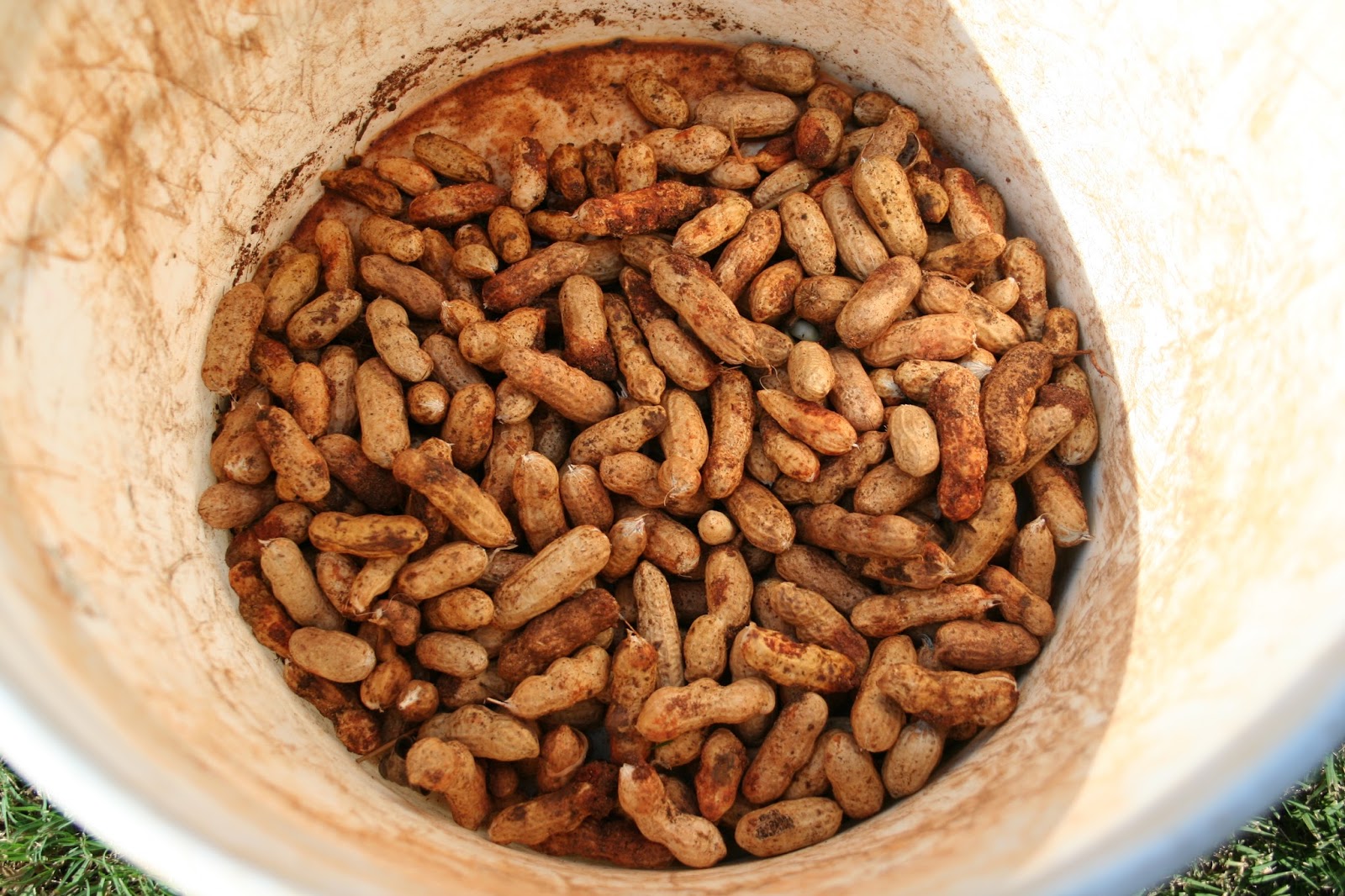
I also started to harvest the peanuts. I harvest by hand. This is a slow process under normal circumstances. With me being sick, it is twice as slow.
It is important to loosen the soil before you pull the plant. (It is very easy to leave some peanuts in the ground if you don't.) After all the plants have been harvested, it is important to turn over the soil a few times to look for stray peanuts. No matter how long I look, I always have some that I missed come up in the spring!
Most of the peanuts clump at the roots.
However, they also grow along the plant stems as well.
Peanuts will continue to grow as long as the plant is in the ground. The key is to pick a time where many of the first peanuts that formed in late spring don't germinate themselves and make new plants, yet give enough time for many of the later formed peanuts to fully develop. For me that is somewhere between September 15 and October 1st. So far, I have only seen a few peanuts germinate to make new plants. This means I should be maximizing how many I get. Only pulled up one three foot row so far and filled the bottom of the bucket.
I am going to juice some more apples this afternoon and go back to pull up additional peanuts later when the sun is gone. Sweating with a chicken pox rash is very uncomfortable!
Do you make your own tomato/pasta sauce? If you have never tried, you really should. It tastes SO much better than anything you can purchase from the store! I love to make pasta sauce. While it is time consuming, it isn't hard.
Here is my recipe:
20 - 24 lbs. tomatoes
1 cup Italian seasoning (I grow and make my own, see recipe below.)
1 cup sugar
1/3 cup minced onions (I grow and dry my own.)
1/4 cup garlic powder (I grow, dry and powder my own.)
2 TBS olive oil
Italian seasoning recipe
2 parts basil
2 parts oregano
2 parts thyme
2 parts marjoram (I don't like marjoram. I usually double up the oregano.)
1 part rosemary
1 part sage
The hardest part of making any sauce is to turn the tomatoes into tomato pulp. I use a Victorio Strainer. It is quick and easy. It cleanly separates the skin and seeds from the pulp.
However, if you don't have one you can plunge tomatoes into boiling water for 1 minute and then plunge them into ice water. That will remove the skins. To remove the seeds, you can use a food mill (I used to use a food mill - it is a bit more work than the Victorio Strainer). I have also read recipe instructions that tell you to puree the pulp and seeds together - if you would prefer to do that.
From this point, add all the ingredients into a large pot and simmer for 2 to 3 hours. That's it! Now, how long you simmer depends on you and the flavor you are looking for. I usually simmer until the sauce is about half of what I started with. While I won't leave the house with the stove on and a pot simmering on the stove, it is not necessary to 'babysit' the sauce either. You can go about your household chores and check the sauce every once in a while - I usually stir it then too.
When the sauce has been reduced by about 1/3 to 1/2 of the original, go ahead and taste it. It is fabulous and full of flavor! You can then can the sauce or freeze it. Sometimes, I will freeze it for a few days until I have time to can it. (If you plan to can your sauce, please follow The Ball Complete Book of Home Preserving. Those recipes are safe to can using the instructions included in the book.)
I can't wait to eat some this fall!
Do you have food security? You should. It is easy to do. Just purchase a few extra of what you normally buy every time you go to the store. Soon, you will have a week's worth of extra food, then two week's worth. Once you have a few month's worth of food in your pantry, you will be ready for most of what you may face when hard times come your way.
By the title of this article, you are probably thinking that most of the world doesn't live in Venezuela, and these are normal times in the USA so why should I bother with food storage.
But, are these normal times? Even though it started out that way in Venezuela, I think we can all say that no one considers it 'normal' in Venezuela any more! Those people are starving.
I received this article in my email from Emergency Essentials. It is a good one. I encourage you to read it. (Full disclosure: I purchase some of my food storage from them on a regular basis - their food is REALLY good!)
Here are a few other articles I wrote on starting and managing a food storage program.
If you don't have any food storage, I strongly encourage you to start. You don't want to be dependent on the government in times of crisis. If you have a food storage program at your house, you may want to increase the number of days you can feed your family without going to the store. It sure brings peace of mind!
I believe it is time to start making tomato sauce!
These won't last long, we will have them for dinner soon!
The corn has a lot more drying to do. I have given up my dining room table until they are ready to store. I got 42 full ears and about 10 more half ears. (The half ears did not have full pollination.) Most of this will be popped for popcorn. The rest will be used to make cornmeal (my husband loves cornbread).
The cotton looks really good! Not all the bolls have opened yet, but you can see some at the bottom that have opened. I haven't picked any yet but will before the week is over. (I will write a series of posts on how to turn it into yarn once I have picked enough.)
I I also picked 7 summer squash. (I forgot to take a picture before I cut them up to dry.)
In addition, I have started the fall garden. Where the corn was, I have planted carrots. I will put the peas in soon. When the green beans are finished, I will put in garlic and onions too.